Navigating Change with Empathy and the Five Cs Framework
Change is a constant in the modern business environment. Yet, despite its inevitability, many organizations struggle to manage it effectively. In a recent fireside chat hosted by Laura Scott, Partner at ADAPTOVATE's Sydney office, Srima McQuillan, a seasoned transformation and change executive, shared her insights on driving successful organizational change. With over two decades of experience in industries ranging from startups to multinational corporations, McQuillan introduced a powerful yet simple framework to guide change: The Five Cs—Clarity, Communication, Collaboration, Culture, and Commitment.
This framework is not only practical but also deeply rooted in empathy, recognizing that change ultimately revolves around people. Here’s how these five pillars can help organizations navigate the complexities of transformation, along with real-world examples of how they’ve been applied.
Watch the full conversation at our YouTube Channel
Clarity: Defining the "Why" of Change
According to McQuillan, clarity is the cornerstone of any successful change initiative. It begins with understanding the fundamental “why” behind the transformation. Why does the organization need to evolve? What is the purpose of the change? And how does it align with broader strategic goals?
Case Study: Unifying Vision in a Merger
McQuillan shared an example from a company undergoing a complex merger, where thousands of employees from different cultures and systems needed to be integrated. Initially, many employees were unclear about why the merger was happening and what it meant for them. Leadership hosted town halls, distributed clear messaging, and engaged managers to cascade the "why" throughout the organization. By aligning leadership and teams on a shared vision, the company reduced uncertainty and rallied employees around a common purpose.
“Clarity isn’t just about knowing what to do,” McQuillan explained. “It’s about understanding why it matters and how it connects to each individual.”
Communication: The Heartbeat of Change
If clarity sets the foundation, communication is the lifeblood that keeps a change initiative alive. McQuillan describes communication as the "heartbeat of change," underscoring its importance in creating momentum and trust.
"Communicate, communicate, communicate," she advised. "It may sound repetitive, but science tells us that people need to hear a message at least six times before it truly sinks in."
Case Study: Driving Engagement Through Creativity
During a digital transformation, a company introduced a new system that employees were apprehensive about. To alleviate fears, McQuillan involved a senior leader who was notoriously non-technical. The leader piloted the system in a 90-second video, showing how easy it was to use while adding humor and relatability. This video went viral internally, sparking curiosity and excitement.
The lesson? “Communication isn’t just about repetition—it’s about creativity,” McQuillan said. By delivering messages through diverse channels like videos, team meetings, and one-on-ones, organizations can ensure they resonate with everyone.
She also highlighted the importance of avoiding surprises. "When leaders communicate big changes without preparation, it can create fear and resistance. Instead, plan the messaging thoughtfully and address concerns openly."
Collaboration: Breaking Down Silos
Collaboration is essential for successful change, but it requires deliberate effort to break down silos and foster a sense of collective ownership. As McQuillan pointed out, large transformations often affect multiple areas of an organization, yet teams can become myopic, focusing only on their specific roles.
Case Study: Cross-Functional Teams in a Global Rollout
In another instance, McQuillan worked with a company launching a global initiative to standardize processes across multiple regions. Rather than relying solely on functional experts, the company formed cross-functional teams that included employees from entry-level to senior leadership. This approach ensured diverse perspectives, reduced blind spots, and created a sense of shared ownership.
“Collaboration makes change possible by turning individuals into a cohesive team,” McQuillan explained. “It empowers teams, creates buy-in, and ensures that the change is seen as a shared journey rather than an imposed directive.”
Culture: The Driver of Sustainable Change
Culture plays a pivotal role in determining whether a change initiative will succeed. In organizations with innovative, adaptable cultures, change often feels natural and fluid. Conversely, in environments where rigidity or silos dominate, change can feel like an uphill battle.
Case Study: Embedding Agile Practices for Continuous Improvement
McQuillan recounted a success story where she helped a company integrate agile practices to foster a culture of continuous improvement. Weekly showcases became a cultural cornerstone, where teams shared their progress in a celebratory environment with socializing and camaraderie. This ritual turned change into something employees looked forward to rather than resisted.
For less adaptable cultures, McQuillan recommends starting small and building trust. In one example, she helped a highly regulated organization implement incremental changes. By openly acknowledging challenges, celebrating small wins, and demonstrating tangible benefits, the organization gradually shifted its mindset from resistance to acceptance.
“When people see that change improves their job rather than adding to their burden, the cultural shift begins,” she said. “It’s about creating a space where change feels empowering, not overwhelming.”
Commitment: Leading by Example
The final pillar, commitment, is about ensuring that leaders visibly champion the change and provide the necessary resources to make it happen. Without leadership buy-in, even the best-designed initiatives can falter.
“Commitment starts at the top,” McQuillan emphasized. “Leaders need to walk the talk. They have to be visible, engaged, and consistent in their actions.”
Case Study: Sustaining a Five-Year Transformation
McQuillan highlighted a five-year system overhaul that required unwavering leadership commitment. Despite the long timeline, leaders remained visible and actively engaged, regularly addressing concerns, celebrating milestones, and reinforcing the importance of the initiative. This visible support built trust and resilience across the organization.
Commitment isn’t just about visibility—it’s also about resource allocation. “Leaders need to ensure their teams have the capacity to support the change. If people are stretched too thin, the change initiative will suffer,” she said.
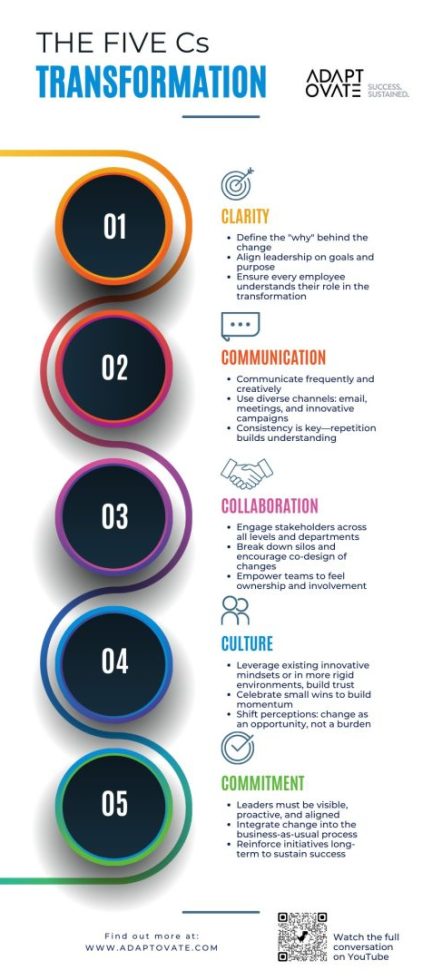
Download our The Five Cs of Transformation infographic below
Sustaining Change: Lessons Learned
McQuillan offered a valuable lesson from her experience: Change doesn’t end when a project is completed. To ensure long-term success, organizations must integrate changes into their business-as-usual processes.
Case Study: Avoiding Change Fatigue
One organization McQuillan worked with made the mistake of running change initiatives parallel to business-as-usual operations, leading to overwhelmed teams and poor outcomes. By realigning the change program to fit within the company’s operating rhythm, they eliminated redundancies and streamlined efforts. The result was a more manageable and effective transformation.
“The sooner change becomes part of your regular business processes, the better,” she said. “When teams see change as part of the company’s DNA, it has a much greater chance of sticking.”
Empathy: The Key to Lasting Impact
Throughout the discussion, McQuillan repeatedly returned to the importance of empathy. Change, she noted, is deeply personal—it affects how people work, think, and interact. By approaching change with understanding and compassion, leaders can build trust, reduce resistance, and foster a positive experience.
“Empathy is what turns a good change initiative into a great one,” she concluded. “It’s about recognizing that behind every process or system, there are people—and they’re the ones who ultimately determine success.”
Conclusion
The Five C’s framework—Clarity, Communication, Collaboration, Culture, and Commitment—offers a comprehensive yet flexible approach to managing change. By combining strategic alignment with empathetic leadership, organizations can navigate even the most complex transformations with confidence.
Through case studies, McQuillan demonstrates how these principles can be applied to real-world challenges. Whether unifying a team during a merger, engaging employees in a digital transformation, or sustaining a long-term initiative, the Five C’s provide a roadmap to success.
As McQuillan aptly put it, “When people see change as a relief and not a burden, the cultural shift begins.” Whether you’re embarking on a digital transformation or reimagining your organizational structure, the Five C’s provide a roadmap to success.
Get in touch
Locations
USA
US Headquarters
695 Town Center Dr, Suite 1100
Costa Mesa, CA 92626
+1 424 543 2623
growth_US@adaptovate.com
AUSTRALIA & NEW ZEALAND
Sydney
L12 50 Carrington Street
Sydney NSW 2000
+61 2 7200 2530
Melbourne
Suite 22-125 120 Spencer Street,
Melbourne VIC 3000
+61 2 7200 2530
Canberra
Suite 3, Ground Floor/65 Canberra Ave
Griffith ACT 2603
+61 2 7200 2530
Auckland (Tāmaki Makaurau)
Level 4, ACS House, 3 Ferncroft Street,
Grafton, Auckland 1010
New Zealand
SINGAPORE
20 Collyer Quay, Level 12,
Singapore
+65 98348486
POLAND
ul. Czackiego 15/17
00 -043 Warszawa
+48 505 626 416
CANADA
296 Richmond St. West
Toronto, ON M5V 1X2
Canada
+1 647 631 1205
UK
5th Floor, 167-169 Great Portland Street
London W1W 5PF
+44 20 3603 1662
PHILIPPINES
19th Floor, Two Neo Building
3rd Avenue corner 28th Street
Bonifacio Global City, Taguig City
+65 98348486



ADAPTOVATE is a proud sponsor of the Sydney Roosters - an Australian National Rugby League team

About us
Key Approaches
Industries
Trending Topics
©2022 ADAPTOVATE. All rights reserved